
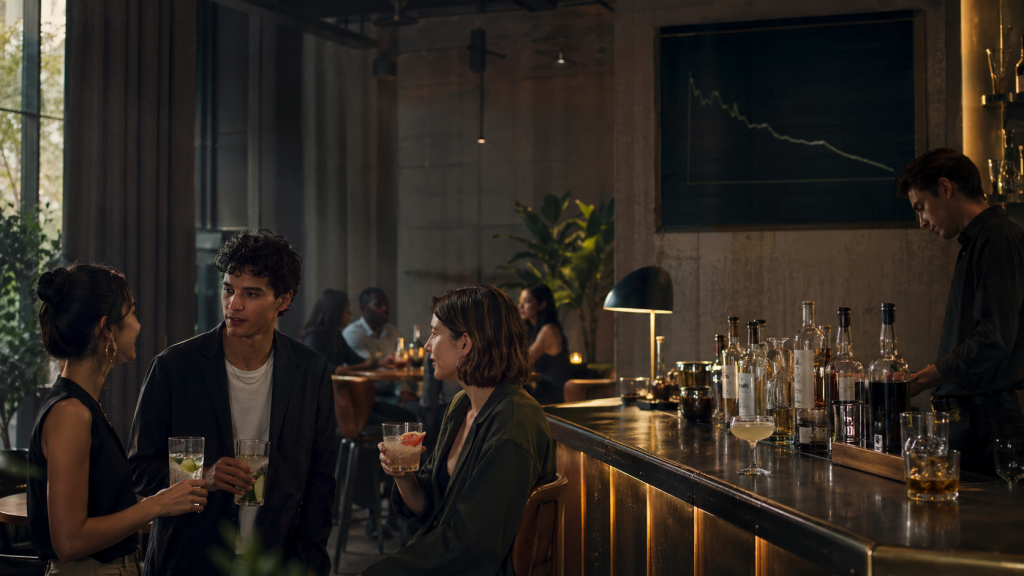
Gen Z is not just skipping the bar tab. They may be rewriting the entire business model of alcohol.
For decades, alcohol seemed almost immune to cultural change. People might switch from beer to wine, from wine to tequila, from cheap bottles to premium labels, but the basic ritual stayed the same: birthdays, weddings, football games, dates, vacations, office parties and Friday nights all came with a drink in hand.
That assumption is starting to crack.
The shift is especially visible among Gen Z, but it is no longer just a youth trend. Americans overall are drinking less, thinking harder about alcohol’s health risks, spending more carefully and looking for social options that do not come with a hangover. The NorthJersey.com story about New Jersey college students captures one of the most modern reasons perfectly: younger people live in a world where one sloppy night can become a screenshot, a video or a permanent social media memory. For them, drinking is not just a health risk or a money drain. It can feel like a reputation risk.
The numbers back up the cultural change. In 2025, Gallup found that only 54% of U.S. adults said they drink alcohol, the lowest level Gallup has recorded in nearly 90 years of tracking. That figure was 62% in 2023 and 58% in 2024, meaning the decline has accelerated quickly. Among adults under 35, the share who drink fell to 50% in 2025.
That is not a small warning sign for liquor companies. That is the customer base thinning out.
The “sober curious” movement is becoming normal
For older generations, not drinking often required an explanation. You were the designated driver. You were on medication. You were pregnant. You were in recovery. You were training for something. You had to give people a reason.
Gen Z has made not drinking feel less unusual.
A younger adult can now order a mocktail, a nonalcoholic beer, a sparkling water or a THC-infused beverage without turning it into a social confession. The language has changed, too. People do not always call themselves sober. They may say they are “sober curious,” “cutting back,” “zebra striping” by alternating alcoholic and nonalcoholic drinks, or simply not in the mood to drink.
That matters because alcohol sales have always depended on habit. If young adults build their social lives without making alcohol the centerpiece, the industry loses more than a single sale. It loses the beginning of a long-term customer relationship.
This is where the future gets especially troubling for liquor brands. The old model assumed that young drinkers would age into whiskey, vodka, tequila, wine and higher-end bottles as they earned more money. But if Gen Z delays drinking, drinks less often or never develops the habit at all, the pipeline weakens.
Health warnings have changed the conversation
For years, alcohol benefited from mixed public messaging. A glass of red wine was framed as sophisticated. Moderate drinking was sometimes discussed as possibly heart-healthy. A cocktail was marketed as lifestyle, relaxation and adulthood.
That story is falling apart.
In January 2025, the U.S. Surgeon General released an advisory linking alcohol consumption to increased risk for at least seven types of cancer, including breast, colorectal, liver, mouth, throat, esophagus and voice box cancers. The advisory also called for stronger public awareness around alcohol-related cancer risk.
That kind of message is hard for the liquor industry to market around. A company can promote heritage, flavor, craft, luxury and celebration. It is much harder to sell a premium bottle when the broader public conversation increasingly includes cancer risk, anxiety, sleep disruption, calories and next-day productivity.
Gallup also found that a majority of Americans now believe moderate drinking is bad for health, which is a major change in public perception. Once a product becomes associated with long-term health damage, the industry does not just face softer sales. It faces a branding problem.
The economy is making the decision easier
Health is one reason people are drinking less. Money is another.
A night out has become expensive. A couple of cocktails, tax, tip, rideshare and food can turn a casual evening into a $75 to $150 decision. For younger adults dealing with rent, student loans, car payments, groceries and shaky job markets, alcohol is an easy place to cut.
Industry data shows that cost is now a major driver of moderation. IWSR reported that U.S. total beverage alcohol volumes fell 5% in 2025, with beer down 5%, wine down 6% and spirits down 4%. IWSR’s consumer research also found that cost was the most common reason U.S. drinkers gave for drinking less.
That is a brutal combination for liquor sellers: younger consumers are less emotionally attached to drinking, older consumers are becoming more health-conscious, and everyone is watching their wallet.
Liquor sales are already showing the stress
The spirits business is not collapsing overnight, but the slowdown is real. The Distilled Spirits Council reported that U.S. spirits supplier sales totaled $36.4 billion in 2025, down 2.2% from the prior year.
That may not sound catastrophic until you look at the bigger picture. Spirits brands spent years benefiting from premiumization, where consumers bought nicer tequila, better bourbon, celebrity-backed vodka and higher-priced bottles for home bars. During the pandemic, many people upgraded their at-home drinking routines. But the post-pandemic hangover has arrived. Consumers are trading down, buying smaller formats, drinking less often or skipping alcohol entirely.
Even exports are under pressure. U.S. spirits exports declined 3.8% in 2025 to $2.37 billion, according to the Distilled Spirits Council, with trade friction and weaker international demand hurting American spirits.
For liquor companies, the problem is not just fewer drinks. It is fewer profitable drinks. A customer who once bought a premium bottle every month may now buy a cheaper bottle twice a year. A bar customer who once ordered three cocktails may now order one cocktail and two sparkling waters. A Gen Z customer may never enter the category at all.
Nonalcoholic drinks are taking the shelf space
The alcohol industry’s biggest future competitor may not be another liquor brand. It may be the drink that looks like alcohol, feels social like alcohol and photographs like alcohol — but contains no alcohol.
Nonalcoholic beer, wine and spirits are no longer a tiny Dry January novelty. NielsenIQ reported that the nonalcoholic beer, wine and spirits category reached $925 million in off-premise sales with 22% year-over-year growth in 2025. NIQ later reported that nonalcoholic beer, wine and spirits surpassed $1 billion in sales in 2025.
That is a major signal. Consumers still want the ritual. They still want the can, the bottle, the glass, the garnish and the feeling of participating. They just do not always want the alcohol.
This is dangerous for liquor companies because nonalcoholic options solve the social problem that used to protect alcohol. In the past, people drank partly because not drinking felt awkward. Now the awkwardness is disappearing. If a person can hold a stylish zero-proof drink at a party, they get the social benefit without the hangover, calories, health worry or expensive bar tab.
Alcohol has lost some of its cultural power
The bleakest part of the future for liquor sales is not just the data. It is the vibe.
Alcohol used to represent freedom, adulthood and celebration. For many younger consumers, it now represents loss of control, bad sleep, wasted money, anxiety, embarrassing videos and feeling terrible the next day.
That is a huge cultural reversal.
The old liquor ads sold confidence. The new consumer wants clarity. The old bar scene sold escape. The new consumer wants wellness. The old premium bottle sold status. The new status symbol may be discipline, fitness, mental health, clean skin, early mornings and having your life together.
That does not mean alcohol disappears. People will still drink at weddings, restaurants, holidays, sporting events and special occasions. Premium spirits will still have loyal fans. Bourbon collectors, tequila drinkers, wine enthusiasts and cocktail lovers are not going away.
But the casual, automatic, everyday drinking occasion is under pressure. And that is where volume lives.
The future may belong to “less,” not “none”
The alcohol industry’s best hope is not pretending this trend is fake. The smartest brands will adapt to moderation.
That means smaller bottles, lower-ABV cocktails, better-tasting nonalcoholic versions, functional beverages, premium mixers, ready-to-drink options and marketing that does not make heavy drinking look glamorous. IWSR noted that ready-to-drink beverages were much more resilient than beer, wine and spirits in 2025, with RTDs down only 1% in the U.S. while other major categories fell more sharply.
But even that adaptation comes with a catch. If the future is lower alcohol, fewer drinks and more switching between alcoholic and nonalcoholic options, then the old growth expectations for liquor may be too optimistic.
Liquor companies can still make money, but they may have to fight harder for every occasion. They may have to accept that the next generation does not see drinking as a default part of adulthood. They may have to compete not only against other alcohol brands, but against coffee shops, cannabis drinks, fitness culture, mocktail bars, sparkling water, sleep apps and the simple appeal of waking up clear-headed.
The bottle is not dead, but the party has changed
People are drinking less because the reasons to drink are getting weaker and the reasons not to drink are getting louder.
Health warnings are louder. Prices are louder. Social media consequences are louder. Mental health awareness is louder. Fitness culture is louder. Nonalcoholic alternatives are better. Younger consumers are more comfortable saying no.
For liquor sales, that points to a difficult future. Not a total collapse, but a long, grinding reset where growth is harder, loyalty is thinner and the old assumption that every generation eventually becomes a drinking generation no longer feels safe.
The liquor industry once sold the promise of letting loose.
The next generation seems more interested in keeping control.
Comments